Commemorative Image of Someone Who Was Murdered Ap Art History

Marsden Hartley, Portrait of a High german Officer, 1914, oil on canvas, 173.iv x 105.1 cm (Alfred Stieglitz Collection, The Metropolitan Museum of Fine art, New York)
A different kind of portrait
I once hired a photographer to accept my picture for a publication. The resulting portrait accurately shows what I looked similar on a forenoon in January 2013: wavy brownish hair with a receding hairline; narrow, pale blue optics aided by blackness-rimmed spectacles; a smiling with a sparse upper lip; broad nose; clean-shaven confront. It even shows what I wore that day: dark jeans, light blue shirt, brownish tweed blazer. This image is an accurate representation of my appearance, but does it tell you annihilation nigh who I am? Would it exist possible for a different kind of portrait to do something else—could it instead describe aspects of my professional or personal identity rather than simply showing how I announced ? If a painter filled a canvass with things that symbolize my life, could that paradigm be just as meaningful an expression of who I am? This kind of "allegorical" or symbolic portrait was exactly what Marsden Hartley achieved in his 1914 Portrait of a German Officer , which he painted while living in Germany during the start of Globe State of war I.
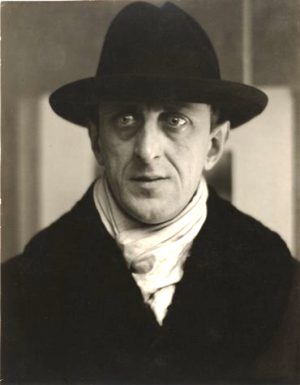
Alfred Stieglitz (lensman), portrait of Marsden Hartley, 1915-16 (San Francisco Museum of Modernistic Art)
New York, Paris and Berlin
Hartley was an American past birth and training: born in Maine, he moved to New York City in 1899, where he studied with the American painter William Merritt Chase and, later, at the National University of Pattern. In New York, he as well met the preeminent advanced photographer Alfred Stieglitz, who owned and operated the prestigious 291 Gallery. Stieglitz not but gave Hartley a ane-person show at the gallery, simply he also introduced the 28-year-old painter to the newest trends in European modernism.
In 1912, Hartley packed his trunks and moved to Paris. In that location, he moved within creative circles that included artists such as Pablo Picasso and Henri Matisse, who both influenced Hartley's piece of work. While in Paris, Hartley also met Arnold Rönnebeck, a German sculptor, and his cousin, Karl von Freyburg, who was then a lieutenant in the German language army. He and Hartley became close, and a number of art historians have suggested that they were lovers. Hartley visited Rönnebeck and von Freyburg in Berlin in early 1913, and moved at that place merely months later. He stayed through the start of the World War I in August 1914, and remained in Germany until December of 1915, when the war was fully and catastrophically underway. While in Federal republic of germany, Hartley also met the High german Expressionists Wassily Kandinsky and Franz Marc, the founders of the Blaue Reiter (Blue Rider) move. An examination of Hartley's paintings during his Berlin years suggests that the abstraction of Kandinsky and Marc likewise had a profound effect on his work.
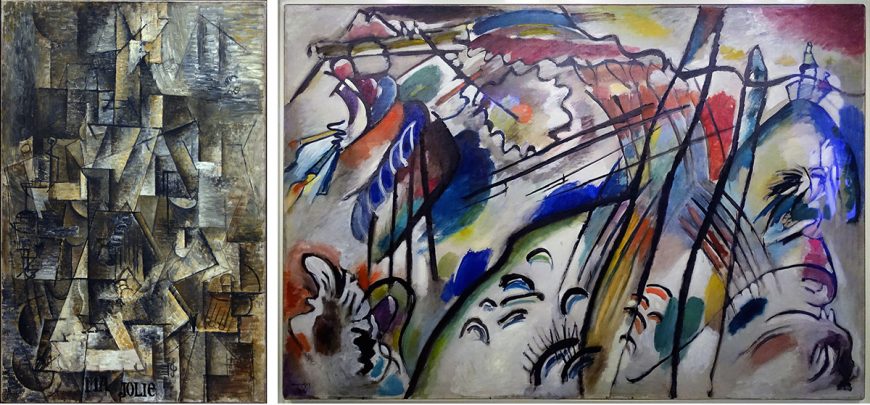
Left: Pablo Picasso, Ma Jolie, 1910-11, oil on canvas, 100 x 64.five cm (photo: Dr. Steven Zucker) (The Museum of Modernistic Art, New York); right: Vasily Kandinsky, Improvisation 28 (second version), 1912, oil on canvas, 111.4 10 162.1 cm (photo: Dr. Steven Zucker) (Solomon R. Guggenheim Museum, New York)
New modes of abstraction
Portrait of a High german Officeholder is a bully example of this abstraction, and information technology is clear that Hartley used elements from both Picasso's Cubism and the German Expressionists to describe non what Karl von Freyburg looked similar, but a portrait that alludes to who and what he was. The painting brings together a cluster of existent-world objects in a fashion that emulates Cubism—the do, pioneered by Picasso and his collaborator Georges Braque, of deconstructing three-dimensional forms and reassembling them on a two-dimensional sail. Hartley'south use of vivid hues and dynamic, linear forms in the painting also brandish the impact of Kandinsky, who was at the time developing a painterly linguistic communication of pure grade and color designed to arm-twist spiritual and emotional responses from the viewer. In utilizing these new modes of abstraction to depict a person, Hartley fundamentally shifted both the nature and office of the traditional portrait.
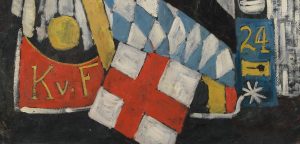
Marsden Hartley, Portrait of a German Officer (particular), 1914, oil on sail, 173.4 10 105.one cm (Alfred Stieglitz Collection, The Metropolitan Museum of Fine art, New York)
Deciphering the portrait
Portrait of a German Officeholder is also a commemorative paradigm of von Freyburg, who had died in October 1914, an early on casualty of Globe War I. It is a surprisingly large canvas—about the height of a human existence. Hartley has filled the composition with the pomp and pageantry of the military. Von Freyburg'due south initials, "Kv.F," are included in the lower left of the painting (left). The red number four on a dark blue field (below) refers to von Freyburg's military regiment, and the yellow "24" refers to his age at the time of his decease.
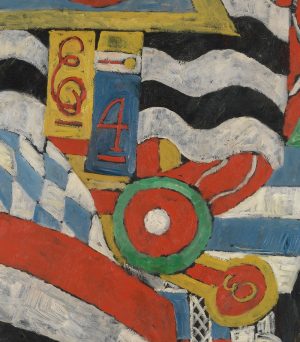
Marsden Hartley, Portrait of a German Officeholder (detail), 1914, oil on canvas, 173.4 x 105.ane cm (Alfred Stieglitz Collection, The Metropolitan Museum of Art, New York)
The letter "E" appears twice in the composition: the red, curvilinear E on a gold background in the middle of the painting (correct) is a battalion marker that refers to the Bayerische Eisenbahn , the name of von Freyburg's railroad battalion. A second cursive East on what looks to be an epaulette in the lower correct could refer to either Hartley's birth name, Edmund, or Queen Elisabeth of Hellenic republic, the purple patron of von Freyburg'due south regiment. The silverish star connecting to a serpentine line near the xanthous 24 is a boot spur, referring to von Freyburg's position as a cavalry officer (higher up) . Finally, the stylized cross with white trim (see image at top of page) is a German Fe Cross—a medal awarded to soldiers who demonstrated infrequent valor. Von Freyburg earned this medal shortly before his death. If we imagine this vertical canvas as an analog to a human figure, this ornamentation might be understood as being worn on the chest, suspended from a blood-red and white striped ribbon.
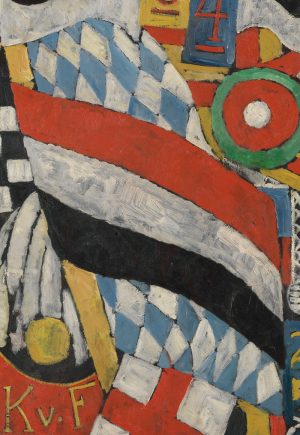
Marsden Hartley, Portrait of a German Officeholder (particular), 1914, oil on canvas, 173.four x 105.i cm (Alfred Stieglitz Collection, The Metropolitan Museum of Art, New York)
Hartley'due south painting is as well more than a portrait of an private: information technology expresses the rising German nationalism that he witnessed while living in Berlin. The diagonal bluish and white checkerboard pattern (left) is a reference to the flag of Bavaria, and and then as well are the pair of bluish and white stripes on the correct side of the image. The red, white, and black stripes on the lesser tertiary of the canvas represent a Kriegsschiffgösch or German naval war flag, turned upside-down. This flag typically had a black cantankerous in the heart of information technology, simply Hartley omitted this element so every bit to bring compositional importance to the medal in the upper part of the painting. Below the German flag are the standards of ii of Germany's enemies: the red and white St. George's Cantankerous of England, and the blackness, xanthous, and cherry-red tricolor of Kingdom of belgium.
More than than appearances
In western bookish painting of the eighteenth and nineteenth centuries, veracity and naturalism (at to the lowest degree to the extent that they flattered the field of study) were prized aspects of portraiture. The renowned early on American portraitist Gilbert Stuart, for example, was said to have "nailed the face to the canvas." Clearly, Marsden Hartley had no such interest in nailing any part of Karl von Freyburg's body to the canvass. Instead, through the employ of military and nationalistic accoutrements, Hartley created an allegorical visual ode to his friend, a portrait that says nothing near his appearance, but communicates much most who and what he was as a person.
Additional Resource:
View this work at The Metropolitan Museum of Art
Townsend Ludington, Marsden Hartley: The Biography of an American Artist, Cornell University Press, 1998.
Cite this page every bit: Dr. Bryan Zygmont, "Marsden Hartley, Portrait of a German Officer," in Smarthistory, February 2, 2017, accessed April 26, 2022, https://smarthistory.org/hartley-officer/.
Source: https://smarthistory.org/hartley-officer/
0 Response to "Commemorative Image of Someone Who Was Murdered Ap Art History"
Postar um comentário