Over Time What Will to Happen to the Populations of Light and Dark Moths on Dark Trees
Written by: Ronald Rutowski and Sean Hannam
Illustrated past: Sabine Deviche
Blending In
Yous walk over the tan-colored sand of the empty desert. You are mid-stride through a fix when a rattlesnake appears out of the sand in front of you, rattling its tail. Luckily it had warned you of its presence. This snake matched its surround almost perfectly, making it very difficult to see.
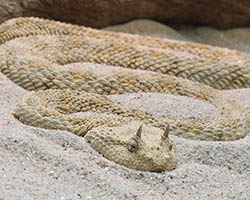
Camouflage is an appearance or beliefs that helps something blend in with the surrounding environment. Click for more detail.
The ability for animals to blend in is what helps many avoid existence eaten past predators. For others, it is what helps them take hold of unsuspecting casualty.
Imagine if that same snake were moved to a green leafy rainforest. The colors that helped the serpent blend into the desert will make information technology stand out confronting the green environment. It will no longer be camouflaged.
This just goes to show you lot that cover-up doesn't work everywhere. What helps you hide in ane place might make you lot stand out in others. So what happens when an animal's surround changes? Let's take a look at one animal species that is famous for changing over fourth dimension to stay camouflaged: the peppered moth.
A Selection of Pepper
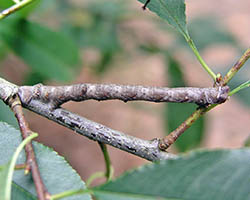
The caterpillar of the peppered moth tin can blend in on some copse, looking like a twig. Click for more detail.
Like many insects, the peppered moth can benefit from blending into its environment. This means its coloration should match with the trees on which it perches. And then, what would happen if the trees began changing, and the peppered moths were no longer able to blend in?
It could adapt to these changes in a number of ways. The individuals could move (to try to find trees that friction match its color). Or the species could take contradistinct behavior, or even change over time to arrange to the new surroundings.
This species has ii dissimilar adult forms. One form of the species, typica, is a pale lighter color that is peppered with blackness speckles. The other course,carbonaria, is a much darker color that is peppered with lite speckles.
From Light to Dark Moths
Moth collectors in England noted that most peppered moths collected in the early 1800's were lite gray peppered with $.25 of black. Many years afterwards almost of the moths collected were near completely black.
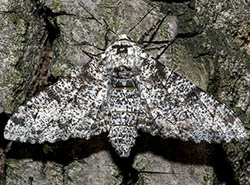
About of the peppered moths nerveless in the early on 1800s were the light class. Click for more particular.
What could have caused the more than common light colored moth to become rare?
Scientists bred the moths and figured out that the light-colored form of the peppered moth has different genes from the dark form. The black colour of the dark form was due to a mutation in the DNA of the light-colored form.
Once this mutation was present, the dark-colored moths would produce offspring with dark-colored wings. Light colored adults that didn't accept the mutation produced low-cal offspring. But genetics is only role of the story.
A Changing World
During the 1800's, Europe and America experienced the Industrial Revolution. Information technology was a time of change in manufacturing processes that led to the building of factories.This enabled humans to make many more things much faster.

In the 1800s, manufacturing processes changed. Click for more detail.
We went from a largely rural society to a city or urban one. Ane of the new fuel sources that was heavily used during this time menstruation was coal. Small amounts of coal can produce large amounts of heat. It near replaced forest in many homes in Europe during this fourth dimension. It was used for heating homes and cooking and it became the primary energy source in factories.
Coal burning released large amounts of smoke and smog into the surrounding surround.This left a layer of black soot on the once lighter-colored copse. The pollution also killed the light speckled colored lichens that grew on the tree trunks. The tree bark was now exposed and dark without the lichens. How did this affect the brindled moth?
The Pepper in Peppered Moth
Like many moths in forests, the peppered moth tends to rest (or "perch") on tree trunks during the day. They practice most of their flying at night. So information technology would probably be a good thing if the moths look similar to the trees that they perch on, right? Then they can be camouflaged from birds that want to consume them.
Before the Industrial Revolution, the light peppered moth was common, while the dark class was very rare. The light moths blended in with the lite-colored trees. Yet, the Industrial Revolution changed the tree colors.
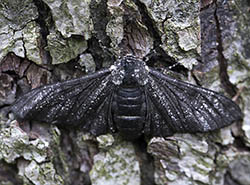
After the pollution from the Industrial Revolution started affecting copse, near of the collected brindled moths were of the dark grade. Click for more detail.
As the copse darkened with soot, the light-colored moths were easier to see. They were eaten by birds more and more, while the rare dark colored moths blended in amend on the darker trees. This made the dark colored moths accept a higher survival rate. They lived longer and passed their dark colored genes onto their offspring or young.
Natural Pick in Action
Over time, the dark colored moths became the more than common of the ii color forms. Natural selection favored the dark individuals, so they were more successful after the copse changed.
Sound a niggling hard to believe? Well, more than observations have come about since these conditions started to reverse, starting in the 1950s. And so, a Make clean Air Act was introduced. Since that time, applied science and cleaner called-for fuels have started to decrease pollution in the areas where the peppered moth lives. The lichen has started to grow once again and the black soot no longer settles on the barks of the trees. Equally expected, the low-cal peppered moth population has recently been more common in the population. This is considering it is improve camouflaged.
Irresolute Colors
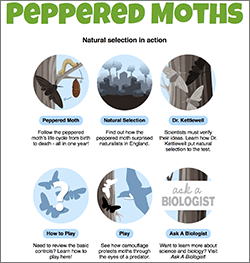
Dr. Kettlewell wanted to know if natural selection was driving the change in moths. Click to visit the game folio and learn more than.
Biologists are curious nearly why coloration can differ amongst individuals in a species. Many scientists want to expect at both how and why a species may change over time.
Scientists like Dr. Henry Bernard Davis Kettlewell used the Scientific Method to exam how and why peppered moth coloration inverse.
Visit Picking Off the Brindled Moth to learn more.
Demand the erstwhile version? Click for the Flash version of the Peppered Moth game.
Images via Wikimedia Eatables. Inconspicuous spider past Matthias 1000.
Source: https://askabiologist.asu.edu/peppered-moth
0 Response to "Over Time What Will to Happen to the Populations of Light and Dark Moths on Dark Trees"
Postar um comentário