Knowledge of the Laws Governing Marriage May Especially Help a Family Practice Whose _____.
What is kid marriage?
Why does kid marriage happen?
How common is kid marriage?
Where does child union happen?
How old are the children involved in kid marriages?
What is the usual age departure between a child bride and her husband?
Are boys ever married off while still children?
What are the consequences of kid matrimony?
Is child matrimony legal?
Is it insensitive to interfere with other countries' religious or cultural traditions around child marriage?
How tin the world end child matrimony?
What will information technology toll to stop child marriage?
What is the difference between child marriage, early marriage and forced union?
What does teen pregnancy take to practice with child marriage?
What is child marriage?
Child marriage is a marriage or union in which one or both spouses are nether 18 years sometime. Although this definition sounds straightforward, the realities of child marriage tin can be complicated. Both the words "kid" and "marriage" are sometimes interpreted differently.
The internationally recognized definition of a child – established by the Convention on the Rights of the Child (CRC), i of the most universally endorsed and widely ratified treaties in history – is "every human being below the historic period of eighteen years". This is also the legal definition used in nigh parts of the world.
Simply in a small number of countries, machismo, or the "age of bulk" may exist reached before age 18. (The CRC makes an exception for national laws recognizing an before age of bulk.) Some countries and cultures consider adulthood a state accomplished upon marriage – for case, countries where full age means the historic period of eighteen years and higher up, and any wife is deemed to exist of full historic period, even if she is under 18. And other countries accept an older minimum age of marriage, such every bit Nepal, where the law requires both men and women be at least xx when they marry.
The concept of marriage also varies – it can be formal or informal, governed by ceremonious law, common constabulary or religious constabulary, or but be a customary practice. In many parts of the globe, for example, marriages may be recognized by the community without legal registration, marked simply with a ceremony. In countries where polygamous matrimony is non permitted by civil law, second and third marriages often have place without formal registration.
Major surveys try to account for this variation when measuring child spousal relationship. Multiple Indicators Cluster Surveys and Demographic and Health Surveys, for case, collect information on the date and age at which women and men were married or outset started living with their first spouses or partners.
Regardless of these varying definitions, kid matrimony is a serious man rights violation that directly threatens lives, health, safety and education of girls and boys, limiting their hereafter prospects.
Why does kid marriage happen?
It can be hard to imagine why someone would choose to have their kid married off. But for millions of people, child marriage can seem like the best – or only – option.
Daughters are ofttimes seen as burdens or commodities because of pervasive gender inequality. Impoverished parents often believe marriage will secure a girl's future by making a hubby or his family responsible for her care. This may be the case when parents face economic hardships or when girls are forced by poverty or circumstance to drop out of school. In places where the helpmate'due south family pays a dowry to the groom'south family unit, younger brides typically command smaller dowries, creating an incentive for parents to marry their daughters off early. In places where the groom'southward family unit pays a bride price, parents in difficult circumstances may marry off their daughters equally a source of income.
Parents – especially in humanitarian crises – ofttimes view marriage equally a manner to protect their daughters from sexual violence. Child spousal relationship rates accept been known to increase during the chaos of war, as families endure both economic instability and fear of violence. Yet kid wedlock itself leads to girls experiencing high levels of sexual, physical and emotional violence from their intimate partners.
Although most adolescent pregnancies in the developing world take place among girls who are already married, in some places, teenage pregnancy – or even the possibility of teenage pregnancy – prompts parents to marry off their daughters. This is seen in both wealthy and poor countries where communities consider pregnancy exterior of marriage to be shameful. Girls may fifty-fifty be forced to marry rapists to spare their families the stigma associated with unmarried pregnancy.
And non all kid marriages are the result of parents' or guardians' decisions. Often, adolescents themselves determine to marry or enter an breezy marriage living with their partner, whether a peer or an older individual. These marriages may be a fashion to practise independence, leave domicile or escape hard circumstances, including desperate poverty or family violence. Restrictions on adolescent sexuality outside of wedlock also bulldoze some adolescents to see matrimony as the only way to exist sexually active.
In well-nigh cases, child matrimony is the issue of girls and families having few choices. Overwhelmingly, when young people take a pick, they ally later.
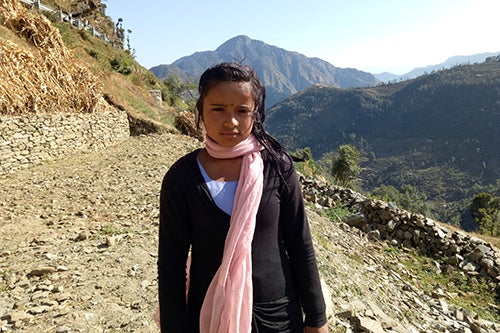
"If I quit my studies, I will be married off immediately," said Kabita, 16, in Nepal. © UNFPA Nepal/Dhana Bahadur Lamsal
How common is child wedlock?
Child marriage is really very common.
More than than 650 million women and girls live today were married before their 18th birthday. Xix per cent of women between the ages of 20 and 24 around the world were child brides. And while child marriage is most prevalent in low- and middle-income countries, information technology likewise takes place in high-income countries.
There is good news: global child wedlock rates are slowly falling. Around 2000, one in 3 women betwixt the ages of xx and 24 reported they had been married equally children. In 2021, this number was merely under one in five. Rates of child spousal relationship before historic period 15 too fell, from xi per cent in 2000 to 5 per cent in 2021.
Still, progress has been uneven and child marriage is non declining fast enough. Considering of population growth in regions where child marriage is more than prevalent such equally West and Key Africa, the rate of turn down is slow and the full number of child marriages is projected to increase by 2030. COVID-19 has besides set back efforts and exacerbated pressures on families thus leading to projected increases in child marriage. To alter this, nosotros must accelerate our actions to end the practice.
Due south Asia has seen dramatic declines in kid marriage over the last decade, and now the global burden of child marriage is shifting to sub-Saharan Africa. Of the almost recently married kid brides, shut to one in three are now in sub-Saharan Africa, compared to one in five a decade ago. While sub-Saharan Africa still has some of the highest rates of child marriage, Southern asia is home to the largest numbers of child brides.
Where does child marriage happen?
Child marriage takes place all over the world.
Information technology fifty-fifty happens in developed countries – including the United States and Great britain. Many people presume that when child marriage takes place in affluent countries, it only involves immigrant communities. This is not the case. Child marriage is known to take place beyond a wide range of communities, ethnicities and religions.
Still, child marriage is much more common in the developing world because i of the main driving factors is poverty.
The highest rates of child union are seen in West and Central Africa, where over four in ten girls were married before age 18. In terms of sheer numbers, South asia is home to the largest numbers of kid brides.
How former are the children involved in child marriages?
Children can be married off at any age. The almost common ages at which children are married are sixteen and 17.
Marriages that take place earlier age 15 are considered "very early marriages." These marriages have a particularly negative impact on girls, interrupting their education earlier and jeopardizing their health more than acutely. Enquiry by UNFPA shows that child matrimony rates increase gradually until age xiv and accelerate significantly thereafter at ages 15 through 17. The bulk of child marriage thus occurs in middle boyhood.
In circumstances where parents are under enormous pressure to marry off their daughters – for those living in extreme poverty or in conflict settings, for instance – marriages take been reported amidst girls around 11 or 12 because girls are seen both as being ready for matrimony and at gamble of sexual violence.
In some cases, children are as young as v when they are married, although this is rare. Extremely immature brides and grooms are sometimes married in anniversary simply but live with their parents until they reach boyhood.
What is the usual age difference between a child bride and her husband?
Children who are married – and they are overwhelmingly girls – tend to have spouses who are much older. When this is the instance, the girls are generally more vulnerable and less able to advocate for their needs and desires.
Demographic and Wellness Surveys (tools for collecting key wellness and demographic information) even track historic period differences between girls and their spouses. This information is used every bit ane of a diverseness of factors to evaluate the well-being of girls in a community.
Still, child marriages are non always unions between girls and much-older men. In some communities, it is customary to wed girls and boys of similar ages. And there are also cases of adolescents marrying one some other voluntarily – sometimes called "love marriages" – and entering cohabiting unions forbidden by family members. Such marriages tin put young people at take chances of retributive violence, and because the spouses often run abroad, they may lack economic support or face social isolation.
Are boys e'er married off while still children?
While the vast majority of child marriages involve girls, boys can also exist married off.
However, UNFPA has constitute that in all 82 low- and middle-income countries for which at that place are data, the prevalence of child marriage is significantly lower for males than females. Only 1 in 25 boys (3.8 per cent) marry before they accomplish age 18, while spousal relationship earlier historic period xv is practically non-existent in boys (0.3 per cent). But 10 countries accept a child marriage prevalence for boys over 10 per cent – including 16 per cent in Madagascar; 14 per cent in Islamic republic of pakistan; 13 per cent in Fundamental African Commonwealth and the Lao People's Democratic Republic; 12 per cent in Comoros, Honduras, the Marshall Islands and Nauru; 11 per cent in Nepal; and 10 per cent in Republic of guatemala.
Child union rates for boys are very low fifty-fifty in countries where child marriage among girls is relatively high.
What are the consequences of child marriage?
Kid marriage undermines children's man rights and derails their lives and time to come opportunities.
At the well-nigh basic level, it denies children the right to choose – with total and complimentary consent and without coercion or fear – whom to marry and when. This is one of life's nearly important decisions.
And there are additional consequences. Child brides are more than probable to become pregnant before their bodies are mature, increasing the risks of both maternal and newborn decease and morbidity. In developing countries, the bulk of births to boyish girls occur within a matrimony or a marriage. In these countries, where access to sexual and reproductive health services is generally low, complications from pregnancy and childbirth can be deadly. In fact, globally, these complications are the leading cause of expiry among adolescent girls.
Children who are married off are also vulnerable to sexually transmitted infections (STIs), including HIV. Contributing to this trouble is the fact that girls who have dropped out of school are more vulnerable to child marriage and less probable to be equipped with information nigh protecting themselves from STIs and unplanned pregnancy.
Child brides are particularly vulnerable to violence and abuse. Young women married as children were ane.5 times more likely to feel concrete and/or sexual intimate partner violence than young women married equally adults. They are less able to abet for themselves and less able to escape calumniating relationships. Mental illness is mutual amidst kid brides, for example, due to their experience of violence. Girls who ally young are also more than likely to think that wife beating is justified than women who ally later in life.
Married girls rarely enrol in school because they are expected to assume pregnant domestic responsibilities. This limits their future potential and makes it harder for their families to escape poverty.
Lack of education and empowerment also hateful girls are less able to advocate for the well-being of their ain children. The children of child brides have higher bloodshed rates, worse nutritional outcomes and tend to be less educated.
Girls in informal unions living with their partners experience many of the same consequences.
Cumulatively, kid union takes an enormous toll on communities, workforces and economies, and the loss is carried over generations.
Is child marriage legal?
Child marriage is almost universally banned.
Ii of the about broadly endorsed human rights agreements in the world, the Convention on the Rights of the Kid (CRC) and the Convention on the Elimination of All Forms of Bigotry against Women (CEDAW), address kid matrimony. The CRC establishes the internationally agreed definition of a child, and the right of children to health, education, protection from violence and protection from sexual exploitation and abuse, all of which are violated by child marriage. The CEDAW states unequivocally: "The betrothal and the marriage of a child shall take no legal effect, and all necessary action, including legislation, shall be taken to specify a minimum age for marriage and to make the registration of marriages in an official registry compulsory." Together, these treaties have been signed or ratified by every land except 1.
All the same, there are some national laws that enable different interpretations of this agreed principle. Many countries allow exceptions with parental consent or under religious or customary police.
Even in places where child marriage is clearly legally prohibited, enforcement tin can be complicated past the fact that many child marriages – and many marriages in full general – are not legally registered.
UNFPA works with governments to abet for stronger laws, historic period- and gender-responsive policies and greater public investment to end kid wedlock. UNFPA is also working with men, women and young people, including adolescent girls, to address the root causes of kid marriage – economic inequality, gender inequality, fears and taboos around boyish sexuality and increasingly, factors such as disharmonize and climate-related fragility. UNFPA besides supports married girls and those in unions, particularly with sexual and reproductive health services and essential services responding to gender-based violence.
Is it insensitive to interfere with other countries' religious or cultural traditions around child wedlock?
There are no major religious traditions that require kid union. Even so child union persists, across many cultures and religions. Child matrimony does not warrant protection as a cultural or religious do – governments effectually the earth have overwhelmingly, and independently, decided that child wedlock is a grave violation of human rights.
In places where child marriage persists, evidence most its harms are usually convincing to policymakers, customs leaders, religious leaders and parents. In fact, in that location are many examples of cultural and religious leaders taking a strong stance against child marriage. Only prohibitions themselves are not e'er sufficient, because child marriage is typically the result of a lack of choices and considering it is viewed every bit the norm. Families, girls, and communities need alternatives to child matrimony that can accept the class of education and employment opportunities, social protection from income loss and catastrophic expenditures and safer, more stable living environments.
How can the world end child matrimony?
Laws prohibiting child wedlock need to be enacted, strengthened and enforced. And more than attention is needed to related laws such every bit on bride price and dowry, marital rape, nascence and marriage registration and mandatory schooling.
But laws lone will not end kid wedlock.
Fundamentally, gender equality must be advanced. When educating daughters is considered as worthwhile as educating sons, when communities – both men and women – give equal weight to the future potential of girls and boys, there is less motivation to appoint in child matrimony.
Boyish girls and boys are less likely to want to marry earlier age eighteen when they are empowered with information almost their sexual and reproductive health and when they are able to determine freely and responsibly matters related to their sexuality, free of coercion, discrimination and violence.
Improved circumstances for families tin can too reduce the incentive to marry off children. Families, including girls, need to be able to live in peace and move in safe. And poverty and economic inequality, which bulldoze so many child marriages, must be eradicated. For this, many changes are needed, including social safety nets for girls and their families, likewise as improved access to quality teaching, health services and economic opportunities.
Girls can play an important office in ending child marriage – when they know their rights and take admission to the correct information and opportunities. UNFPA has seen that when girls are empowered to claim their rights, they can persuade their families to delay or cancel engagements. Instead, they can stay in school, gain skills and support their families economically. Many have been inspired to become advocates and leaders in their communities.
UNFPA and its partners work to bring these changes to the nearly vulnerable girls. The UNFPA-UNICEF Global Programme to Accelerate Action to Terminate Child Marriage is reaching girls in 12 countries in Asia, Africa and the Centre Eastward, and mobilizing a motility against child wedlock globally. The programme takes a gender-transformative arroyo to empowering girls with life skills and comprehensive sexuality education, increasing girls' admission to education and health-care services and educating parents and communities on the consequences of child spousal relationship, thus transforming harmful gender norms and stereotypes at the community levels. It is also contributing to a more girl-friendly legal and policy surround, and generating data on what works to accost child matrimony and related issues such equally adolescent pregnancy, gender-based violence and HIV.
What will it price to finish child spousal relationship?
In November 2019, UNFPA released a joint report with the Johns Hopkins University, in collaboration with Victoria University, the University of Washington and Avenir Health, assessing the price tag to terminate child marriage in 68 countries that business relationship for near ninety per cent of the phenomenon. Ending kid marriage in these countries by 2030, researchers concluded, is surprisingly affordable: it would toll just $35 billion.
In other words, it costs roughly $600 to spare each child bride.
The $35 billion investment – in educational interventions, empowerment initiatives, and programmes that modify social norms around child marriage – would avoid approximately 58 million child marriages. On top of that, girls who escape early marriage volition be able to "make a more productive contribution to the household enterprise," yielding significant benefits to their communities over time.
What is the deviation betwixt child marriage, early marriage and forced marriage?
People occasionally refer to the term "child, early and forced marriage." This creates the impression that these terms are distinct. In fact, they are overlapping.
Child marriage and early spousal relationship largely refer to the aforementioned matter: marriages in which one or both spouses are under xviii years quondam. However, early marriage is also sometimes used to depict marriages in which one or both spouses are 18 or older, but with a compromised power to grant consent. For instance, the marriage of a 19-year-old who is non physically or emotionally mature, or who does not have sufficient information almost her choices, would exist considered an early spousal relationship.
Forced marriage is a matrimony in which one or both spouses do not requite full and free consent, regardless of historic period. Forced wedlock can also refer to a marriage in which 1 or both spouses are unable to end or leave the matrimony.
Because in virtually countries children are non considered able to give legal consent, all kid marriages are sometimes considered forced marriages. However, there are many instances of two adolescents under the age of 18 marrying each other voluntarily, chosen "love marriages" in some contexts.
What does teen pregnancy have to exercise with child spousal relationship?
In the developing world, a majority of adolescent births (those amid girls between the agee of xv and 19) take place amid girls who are already married or in union. This ways that child marriage is often a forerunner to early on pregnancy, which poses a host of health risks to girls whose bodies may not nonetheless exist mature enough for motherhood. Globally, complications from pregnancy and childbirth are the leading crusade of death among adolescent girls.
In some places, the causality is reversed. While most adolescent childbearing occurs inside marriage, it is non uncommon for first births that occur within marriage to be the event of premarital conceptions. The median proportion of boyish girls whose pregnancy preceded marriage just resulted in a birth inside spousal relationship is 18 per cent; this phenomenon is more than common in Africa than in other regions. Teenage pregnancy is oftentimes an incentive for parents to marry their daughters off. This is seen in countries all over the world where communities run across pregnancy outside spousal relationship as shameful. Girls may even exist forced to marry rapists to spare their families the stigma associated with unmarried pregnancy.
Globally, kid marriage and adolescent pregnancy are two major life events that have a pregnant and disproportionate negative touch on adolescent girls. Ane in five girls globally is married as a child, and a tertiary of women begin childbearing in adolescence.
Last updated four Feb 2022
Source: https://www.unfpa.org/child-marriage-frequently-asked-questions
0 Response to "Knowledge of the Laws Governing Marriage May Especially Help a Family Practice Whose _____."
Postar um comentário